Prototype rulebook · draft of 20 October 2026 · PDF: Learning Book (32 pages, 3.6 MB) · Reference Book (8 pages, 1.1 MB)
AEGEAPOLIS
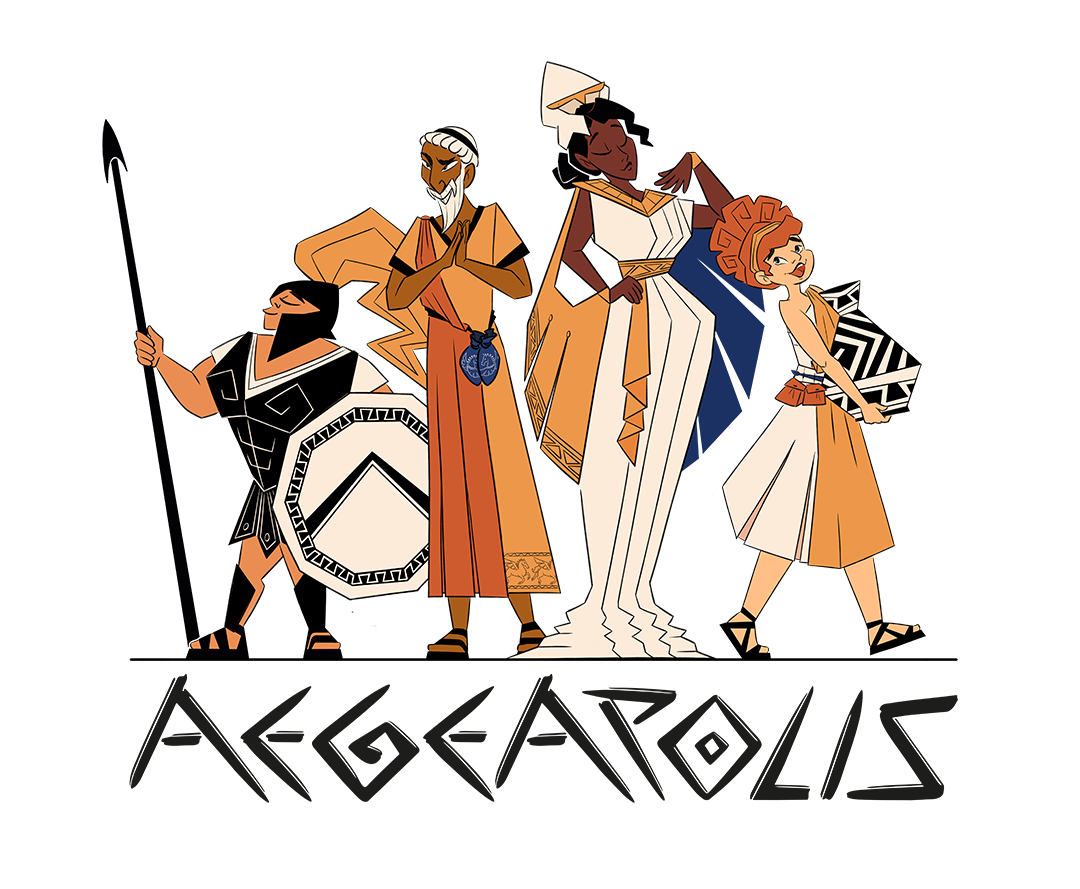
A strategy game of trade, war, and shifting allegiance in the Peloponnesian War.
Sandbox: 2–4 players · ages 14+ · 90–240 minutes
Welcome to Classical Greece
431 BC. The Aegean is a scatter of proud city-states, and the long war between Athens and Sparta has begun. You take the helm of one Polis and steer its fate across eleven years — founding trade, raising armies, conquering rival cities, and minting the coins that will outlast you all.
AEGEAPOLIS is a competitive strategy game. Trade is not required, but it is rewarded: each faction's home city is stronger in some resources than in others, so players are drawn toward trading. The art is knowing how far to cooperate before you hand a rival the win.
You play the leader of one of four factions, each with its own character and special strength:
- Athens — Athene (blue) · strength: discovering Poleis and expanding
- Sparta — Leonidas (black) · strength: conquering Poleis
- Corinth — Sisyphos (terracotta) · strength: economy and security
- Thebes — Phix (cream) · strength: decisive local superiority and economy
The goal: be the player with the most victory points (VP) when the game ends. You earn VP mainly by controlling Poleis, by committing coins at scoring, and by completing Mission Cards. These are not three separate races: the board is what bridges the path of conquest and the path of coins — every city you hold feeds both.
Game Components
Shared components
- 29 Polis tiles
- 28 Mission Cards
- 80 Fleet Points (FP) — blue tokens (trireme)
- 40 Army Points (AP) — red tokens (hoplite helmet)
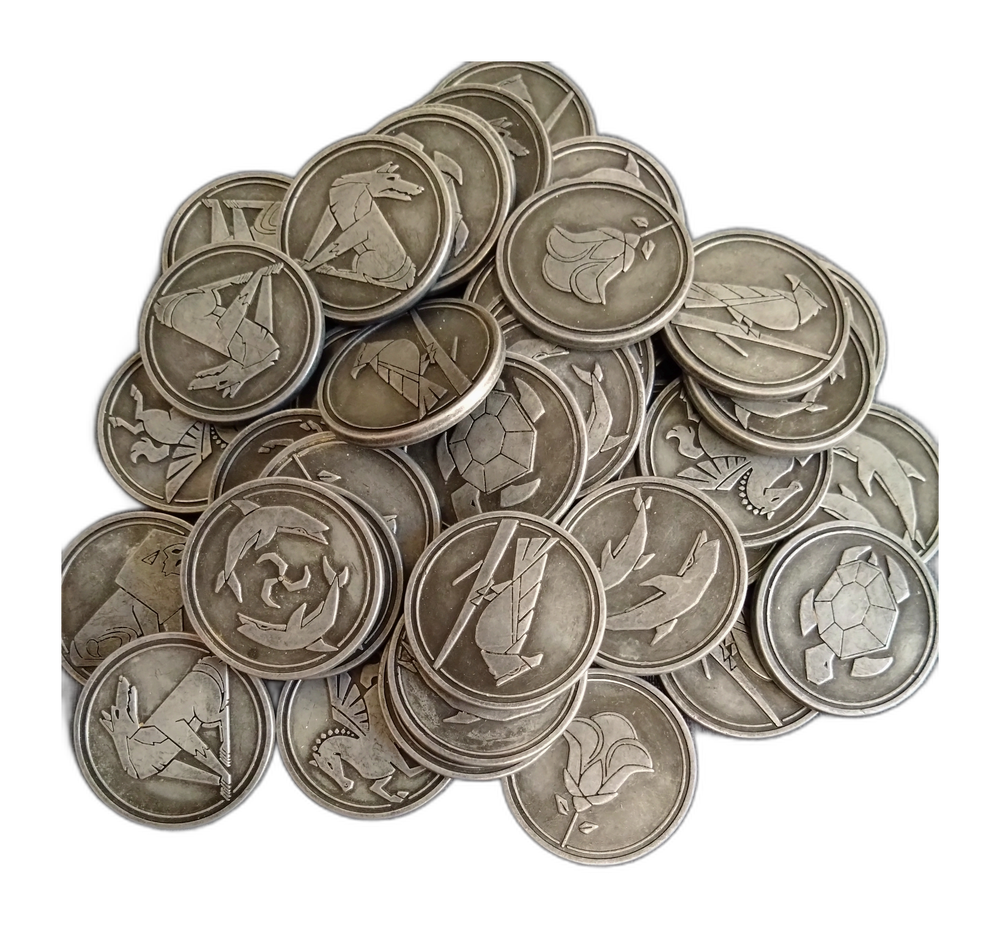
- 40 Minted Coins — 8 designs × 5 each, minted at the 8 Mint cities (Abydos · Aegina · Argos · Corinth · Megara · Milet · Rhodes · Thera). Two designs show dolphins: Thera (two dolphins) and Megara (dolphins with a triskele).
- 20 Unminted Coins
- 1 coin bag (cloth, for the Minted Coins)
- 1 draw-bag (cloth, for player order)
- 4 standard dice
- 4 Spartan dice (black)
- 4 player screens
- 1 tableau (forms of government, timeline, seasons, Path to Victory scoring track)
- 1 season marker — a plain round wooden piece, natural color
- 1 Oblique Order token (Thebes)
- 1 EUNOMIA token (Sparta)
- 5 Builder pawns (Corinth)
- 20 Fortification tokens (Corinth)
- 4 Crossed Bridges (2 parts each = 8 pieces) — special trade links for two trade routes that physically cross
- Neutral Phalanx units in white: 40 single (×1), 5 five-unit (×5) — the defenders of the neutral Poleis, in a color no player owns
- 4 player aid sheets "1 of 2" + 4 player aid sheets "2 of 2" (A6, double-sided)
Per player color (blue · black · terracotta · cream):
- 1 King (crown figure)
- 11 Heroes — 3 Navigators, 4 Fighters, 4 Assassins
- Phalanx units in three denominations: 20 single (×1), 10 five-unit (×5), 5 ten-unit (×10)
- 10 Trade Links (bridges)
- 10 control markers ("houses") — placed on a Polis to show you control it
The box also holds 12 Greek Letter tokens. They belong to the Campaign mode and are not used in this game.
How the Game Works
The game runs for eleven years (431 BC → 421 BC), and each year has four seasons: spring, summer, fall, winter.
A year plays out in up to four phases:
- Prosperity (spring of odd years only — 431, 429, 427, 425, 423 BC) — your cities pay out resources.
- Actions (spring, summer, fall) — each player takes exactly one action, in player order; once every player has taken their one action, the season ends. There is no passing.
- Scoring (end of even years — 430, 428, 426, 424, 422 BC — and after the final year 421 BC) — players score VP.
- Catch-Up (every winter) — each pressured player receives defensive reinforcements (a flat 6 Phalanxes, once).
Player order is set each season (except winter) by a draw-bag: each player has one ×1 phalanx token in their color in the bag. Draw one — that player starts the season; the rest follow in table order. Put the drawn token back into the bag; the bag stays with that player. After the season, the player who started it advances the season marker and draws the next starting token.
Winning: the game ends the moment a player reaches 30 VP after a scoring step (or an Instant Mission Card can end it early — see End of the Game). Whoever has the most VP wins.
Setup
- Choose the factions. With 2 or 3 players, that many factions take part; players choose which. The setup diagrams show only example arrangements of colors: they do not fix any faction to a seat or leave one out.
- Take your faction. Each player takes one Native Polis and all components in that color, plus a player screen.
- Build the board. Each player places their Native Polis at an outer point of the play area:
- 4 players: a 5 × 5 board — Native Poleis in the four corners; up to 21 more tiles can be discovered.
- 3 players: a tapered 19-space board — three outer points; up to 16 more tiles.
- 2 players: a smaller 13-space board — the two Native Poleis at opposite outer points; up to 11 more tiles.
At the start, only the Native Poleis are on the table.
- Form the Polis deck. Shuffle the remaining Polis tiles face down to form the Polis deck. The rest of the board is revealed tile by tile through the Discover action (page 12) as the game unfolds.
- Deal Mission Cards. Give each player 7 Mission Cards. Keep 3, return 4. Shuffle the returned cards face down into a draw pile. (With fewer than 4 players, also shuffle the undealt cards into that draw pile.)
- Choose a starting government. Looking at the 3 cards you kept, each player picks a starting form of government: Monarchy, Democracy, or Aristocracy (see page 23). Take the matching piece (a King for Monarchy). Mark it on the tableau: place one of your ten-unit (×10) Phalanxes on that government's space.
- Prepare the supplies. Sort FP, AP, Minted Coins, and Unminted Coins into a shared supply. Put the Minted Coins in the coin bag. Place the tableau and the season marker on year 1 (431 BC). Each player places one single (×1) Phalanx on space 0 of the Path to Victory and puts another into the draw-bag.
You are ready to begin — spring of 431 BC.
Key Terms
| Fleet Points (FP) | Blue resource. Move armies and build trade links. |
| Army Points (AP) | Red resource. Recruit Phalanxes (1 AP → 4 Phalanxes). |
| Phalanx | A Greek combat unit. Plural: Phalanxes. Has 1 hit point. The ×1 / ×5 / ×10 tokens are only denominations for making change — not units of different value. |
| Minted Coin | A coin bearing a mint's design. Used in trade, scoring, and coin-combo Mission Cards. |
| Control | You control a Polis once you take it — as your starting Native Polis, by conquest, or by handover (by agreement the owner moves out and you move in — one action each) — and mark it with a control marker. Control persists even when no units stand on the tile, until a rival conquers it. Control is what counts for Prosperity, the Poleis ranking, the Mint ranking, and Monopoly cards. |
Phase 1 — Prosperity


In the spring of every odd year (431, 429, 427, 425, 423 BC — never 421), every Polis you control pays out to your supply. What a Polis pays depends only on the resources printed on its tile. Being a Mint adds nothing to the payout — a Mint pays exactly what its tile prints, like any other Polis, and is never a source of extra coins (a Mint counts only for the Mint ranking in scoring).
Your Native Polis pays its full printed offer:
- Athens: 5 FP + 1 AP
- Sparta: 3 AP + 2 FP
- Corinth: 2 FP + 1 AP + 1 Minted Coin
- Thebes: 2 FP + 1 AP + 1 Minted Coin
Every coin paid out is drawn blind from the coin bag — reach in without looking and take one coin; do not search by touch for a particular shape. Even Corinth, which is a Mint, simply draws a random coin.
Each other Polis you control pays:
- Wealthy Polis → 1 Minted Coin (random draw from the bag).
- Common Polis → 1 FP or 1 AP (your choice).
Phase 2 — Actions
On your turn you take exactly one action, then it is the next player's turn. The seven actions are: Discover (page 12) · Build Trade Link (page 13) · Trade (page 14) · Recruit (page 17) · Move & Combat (page 18) · Mission (page 17) · Change Government (page 23). (Corinth has an 8th action — page 28.)
At any time you may also make transactions with the active player — exchanging coins, FP, AP, Mission Cards, or non-binding promises. Transactions are free-form and do not cost your action. What you say about a traded item must be true — a transaction takes effect at once. You do not have to reveal everything: you may name only some of the coins you offer, or let your partner look at a card first. Only promises for the future are not binding.
Discover
Discover brings a new Polis onto the board — one you can later trade with or conquer.
Place a new Polis tile on an empty space next to a Polis you control (horizontally, vertically, or diagonally). Name the space first, then take the tile. The tile comes from one of two sources:
- Polis deck — draw a face-down tile and place it face up.
- Discard pile — take the top, face-up tile (only the top tile is available).
You may spend FP to extend the action:
- Standard (free): place 1 tile (from deck or discard).
- Choice (+1 FP): draw a second tile for the same position (from either source). Keep one, place it; the other goes face up on the discard pile.
Double-discard: during Choice, if you like neither tile, place both face up on the discard pile (you choose the order) and place nothing this turn.
- Trade link (+1 FP): also build a trade link to the new Polis as part of the action.
The two upgrades stack — maximum action cost 2 FP (Choice + Trade link).
Build Trade Link
Trade links connect Poleis into the routes that every trade runs along.
Build a trade link (bridge) between two neighboring, already-discovered Poleis. The first link in the action is free; a second link in the same action costs 1 FP.
To build, you must control one of the two Poleis or already have a link reaching one of them. A player who controls a Polis being connected may forbid the link. Several players may each build a trade link between the same two Poleis — there is no limit. Trade links can never be destroyed.
Trade
Outside Prosperity, trade brings you the goods of a Polis — one of your own, a neutral one, or one held by another player.
Every trade
A trade always runs between two Poleis connected by a trade route. The route may pass through other Poleis. Those Poleis are not part of the trade. Their owners may forbid the trade, or ask for something in return before it happens. The same is true for the owner of every trade link along the route. This is called a concession: open negotiation over resources, cards, or promises, never a fixed toll. Each owner along the route may demand their own concession separately.
One action = one trade = one target Polis. You cannot chain several trades in a single action.
Coins in a trade. Every Minted Coin a trade pays out is drawn blind from the coin bag, exactly as in Prosperity. Trading with a Mint gives you no particular coin.
There are three kinds of trade:
ATrade with your own Polis.
- Your Native Polis receives the goods of one of your other Poleis.
- Place one Unminted Coin on that Polis's tile. It blocks one resource group there, exactly as on a neutral tile.
BTrade with a neutral Polis.
Always runs to your Native Polis.
- You receive the neutral Polis's goods.
- Place an Unminted Coin on its tile. Each Unminted Coin on a tile blocks one resource group (the AP group, the FP group, or the coin offer — you choose which to give up). A newly placed Unminted Coin blocks a group only from the next trade onward, not the trade that places it.
Supply empty? If no Unminted Coin is left in the shared supply, the trade still happens. No coin is placed, so no new group is blocked. The coin is not placed later.
CTrade with another player.
- You and your partner each nominate one Polis you control. Neither has to be a Native Polis, though either of you may nominate your own Native Polis (with its full printed offer).
- Both nominated Poleis must sit in a single trade network. That network must be connected by route — directly or through bridged Poleis — to your Native Polis (the active player's). Owners along that route may forbid the trade or ask for a concession first, as in every trade; if a third player refuses, either side may nominate a different Polis.
- Both players must agree to the other's nominated Polis.
- You (active) receive all goods offered in the partner's nominated Polis.
- Your partner (passive) receives one resource group offered in your nominated Polis.
- Each of you takes any Unminted Coins lying on the other's nominated Polis, behind your own screen. No new Unminted Coin is placed in a player-to-player trade, and blocked groups do not apply.
Recruit
Recruiting gives you Phalanxes — the units that conquer and defend Poleis.
Spend Army Points (AP) to raise Phalanxes only in your Native Polis: 1 AP → 4 Phalanxes. You may spend any number of AP in one Recruit action. There are no upkeep costs.
Mission
Mission Cards are your hidden goals — each new card gives you more to choose from.
Draw one Mission Card (see Reference Book, page 2). You may hold and trade cards; their VP only count when revealed.
Move & Combat
Move & Combat sends your Phalanxes out — to strengthen your own Poleis or to conquer others.
Spend Fleet Points (FP) to move Phalanxes (and Heroes) out of one Polis. If a destination is not yours, combat follows (see page 20).
Cost: count all the units you move, then divide by 4 (round up) and multiply by the distance to the farthest destination — that many Fleet Points. Movement may be horizontal, vertical, or diagonal, and may pass over empty spaces. No trade links are needed to move.
Spread movement. A move sends units from one starting Polis to up to three destinations. Key rules:
- No picking up on the way — every unit starts at the same Polis and ends at one of the (up to three) destinations.
- One cost for the whole spread. Count all the units leaving the starting Polis, divide by 4 (round up), then multiply by the distance to the farthest destination. That is the whole cost — there is no path-by-path comparison. Spreading out is rewarded: reaching up to three destinations still costs only that single farthest distance.
- The King and Builder never count toward the units-per-4 cost (they move for free).
- Builders may split to different destinations in a spread move — each Builder must travel with at least 1 Phalanx (it cannot move alone).
- Each Navigator in the moving force reduces the total FP cost by 1 — applied last, after any Convergence (minimum 0).
- If the move triggers several combats, the attacker chooses the order of the battles.
Convergence (+1 FP). This is a paid exception to the spread rule. Spend 1 extra Fleet Point to also pull up to 4 more units onto that destination — taken from one tile next to it (horizontally, vertically, or diagonally). This bundles forces from a second tile for a single move or attack. The converging units arrive with the move, before any combat; you cannot add them during or after a combat. The neighboring tile's King and all of its Builders ride along for free, exactly as in a normal move — in addition to the up to 4 units. They do not count toward the 4 units, and they add nothing to the Fleet Point cost. This lets you bring a King — and its combat bonus — into an attack that starts from a different tile. Convergence may be used once per Move action.
Combat
Combat happens when you move units into a Polis held by another player or a neutral Polis. If the target has no Phalanxes, you conquer the Polis automatically. A Fortification alone does not defend it — you take the Polis without a fight and inherit the Fortification intact. If at least one Phalanx defends, you fight the battle across one or more combat rounds. A Fortification helps only when a Phalanx defends with it.
When you conquer a Polis, you take all Unminted Coins lying on it behind your screen.
Terms: a combat is the whole fight · a combat round is one side firing · a combat-round roll uses at most 4 dice — a larger army still fires only 4 this combat round, then the other side goes.
Sequence — defender first, then attacker, alternating:
- Each side rolls one die per Phalanx, at most 4 dice per combat round. A 3, 4, 5, or 6 is a hit. With more than 4 Phalanxes you still roll only 4 dice this combat round; then the other side goes next.
- Each hit removes 1 hit point from an enemy unit. A Phalanx has 1 hit point; when it loses its last, it returns to the supply. A Fortification on the tile takes the attacker's hits first; beyond that, the player who is hit chooses which Phalanxes they lose.
- Losses are removed immediately after each roll. The next combat round follows the same way.
- Combat ends when one side has no Phalanxes left on the tile. Because the defender fires first, an attacker reduced to 0 in the defender's combat round never fires back — the defender keeps the Polis.
For a neutral Polis, the player to the left of the active player rolls the dice for that Polis, but the attacker still chooses which Phalanxes they lose. If a spread move triggers several neutral combats, the same player rolls for each, in the order the attacker chooses.
Defense values: Common Polis = 2 Phalanxes, Wealthy Polis = 4 Phalanxes.
Retreat (attacker only)
After any defender's combat round, and before your own combat round, the attacker may retreat instead of continuing the fight. The defender can never retreat.
- Where to: one adjacent Polis that is your own or undefended (has no Phalanxes) — if none is adjacent, you cannot retreat. Moving into an undefended foreign or neutral Polis conquers it automatically, and you take its Unminted Coins.
- Cost: the movement ratio — 1 Fleet Point per 4 retreating Phalanxes and Heroes — paid from your pool (the King and Builders cost no Fleet Points). With no Fleet Points, you cannot retreat.
- It is not an extra action: it is a reaction within your current move-and-combat turn.
Your surviving Phalanxes move to that Polis and the combat ends.
Hero & King effects in combat
- Fighter: in your first combat round of a fight, adds +2 dice above the cap of 4 — on attack or defense. Fighters stack: up to 4 Fighters add +8 (up to 12 dice in that combat round). From your second combat round on, the normal max of 4 applies. The Fighter is not used up.
- Assassin: kills one enemy Phalanx before the battle — on attack or defense (on defense, before the defender's first combat round). The pre-kill bypasses any Fortification and removes a Phalanx behind it. The opponent chooses which Phalanx they lose.
- King (Monarchy): does not fight, but Phalanxes on the King's tile hit on 2–6 (83%). To strengthen an attack, the King must move onto the contested tile with the attacking army — and shares its risk of dying.
Spartan dice (Sparta) — EUNOMIA banking
Spartan dice replace any of the dice rolled — including a Fighter's — they are not extra dice, and their hits count double. The Spartan dice are black: for every 2 banked losses you spend, one white die is replaced by a black Spartan die. As with all dice, at most 4 Spartan dice count in a single combat-round roll.
- Bank your losses. Every Phalanx Sparta loses in combat is stored on the EUNOMIA token — across all combats, with no cap (physically, the lost army tokens themselves — five ×1 tokens may be exchanged for one ×5 token, and one ×5 token back for five ×1).
- Cash them in. Before each combat round, Sparta freely chooses how many banked losses to spend. Every 2 banked losses → 1 Spartan die (2 : 1), limited by the dice you actually roll (at most 4 per combat round). Spent losses leave the token. With fewer than 2 banked losses, no Spartan die is available.

Forms of Government
Your government is chosen at setup and may be changed later. Changing government takes a full action. Move your ten-unit (×10) marker to the new space.
Monarchy
You have a King piece. It moves like a Phalanx (and rides free), does not fight, but strengthens the Phalanxes on its tile so they hit on 2–6 (83%). The King cannot be chosen as a target on its own: as long as any unit of its army remains, the King survives. Only when the last unit of that army dies does the King fall with it — and you get a new one the following year in any Polis you control. When you change away from Monarchy, the King weakens. It then strengthens only the first 4 dice of your first combat round in each combat it takes part in: these 4 dice hit on 2–6, every later die on 3–6. This also applies when Fighters or the Oblique Order add dice to that round: the King still strengthens only the first throw of 4 dice, not the extra dice.
Democracy
Trade-focused. You receive 1 Unminted Coin for every trade you take part in — as long as one is left in the shared supply. A coin that could not be paid out is not paid later.
Aristocracy
Every time you Recruit, you also gain Heroes:
- Phalanxes = AP × 4 (as always)
- Heroes = 1 per 3 AP spent, rounded up — 1 Hero for 1–3 AP, 2 for 4–6 AP, 3 for 7–9 AP, 4 for 10–12 AP.
You choose each Hero's subtype as you recruit it. The caps below equal the figures in your color — you can never have more:
- Navigator — reduces total movement cost by 1 per Navigator moved (max 3 per player).
- Fighter — in your first combat round, adds +2 dice above the cap of 4 (stacks; see Combat) (max 4 per player).
- Assassin — kills 1 enemy Phalanx before the battle, on attack or defense (max 4 per player).
Phase 3 — Scoring
At the end of every even year (430, 428, 426, 424, 422 BC) and after the final year (421 BC), the winter scoring runs in a fixed order:
- Before scoring — players may redeem winter Mission Cards that act first: Monopoly, Coin multiplier, Coin combos & flushes, and Extra scoring.
- The three rankings — Poleis, then Coins, then Mint.
- After scoring — the Second-coin-scoring cards resolve.
Each player may redeem at most one winter Mission Card per scoring (see Reference Book, page 3).
For each ranking, places are scored from the top down — 1st = 3 VP, 2nd = 2 VP, 3rd = 1 VP, one rank per player (a 4th place scores 0; in the Coin and Mint rankings, only players who commit coins are ranked). With 2 players, only the top two ranks apply — 3 VP / 2 VP. Ties share the better rank.
1 — Poleis ranking (open). Count the Poleis each player controls. Rank and score.
2 — Coin ranking (secret fist-commit — each player hides chosen coins in a closed hand, then all reveal at once).
- Behind your screen, take any number of coins you own (Minted or Unminted) into your closed fist.
- Everyone holds a fist out toward the center — even an empty one.
- On "3 – 2 – 1," everyone turns the fist over and opens it at once.
- Rank by the number of coins committed; score 3-2-1. An empty fist gets no rank and no VP — only players who commit at least 1 coin are ranked.
- Committed coins leave you: Minted Coins go back into the coin bag, Unminted Coins into the shared supply. They are not returned.
3 — Mint ranking (secret fist-commit, same as above) — but you may commit only coins whose mint you currently control. Unminted Coins never count here. No Mint controlled → you still hold an empty fist out toward the center. It gets no rank here either. Committed coins leave you the same way.
Phase 4 — Catch-Up (winter)
Every winter, each pressured player is reinforced. In a scoring year, the board is checked only after the scoring is complete: if one or more rivals have Phalanxes on any Polis next to your Native Polis, you receive a flat 6 Phalanxes in your Native Polis — once, regardless of how many rival armies or adjacent tiles are involved.
The trigger is the same in every case: it does not matter why the rival is there (trade-route control, a wealthy neighbor, simple aggression). The adjacent presence of enemy Phalanxes is the whole trigger — no more. The reinforcement is a flat 6 Phalanxes, independent of your government.
A Sample Year: Spring to Fall
Thebes (Phix), spring to fall of 429 BC — one action per season.
Phix is short on coins and wants to build her hand before the next scoring, at the end of 428 BC.
Turn 1 — spring (Trade): Phix's route reaches a neutral Wealthy Polis, Naxos. She trades: her Native Polis receives Naxos's goods — 3 coins, 5 FP. An Unminted Coin is placed on Naxos, blocking its coin group for next time. She chooses to forgo nothing else; the coins go behind her screen.
Turn 2 — summer (Move & Combat): She moves 4 Phalanxes one tile onto a Common Polis (2 Phalanxes defense). Cost: ⌈4/4⌉ × 1 = 1 FP. Defender rolls first (2 dice), then Phix (4 dice). Within a few combat rounds she defeats the defenders and conquers it — gaining a Polis for the Poleis ranking.
Transaction (any time): Athene offers Phix 2 AP for 1 Minted Coin. Phix declines — she needs the coins for scoring.
Turn 3 — fall (Mission): She draws a card and holds it face down. It is a Coin combo (Four Pairs) — a plan for the scoring at the end of 428 BC.
This is the rhythm of every turn: one action, then the table reacts. The depth is in which action, and in the bargaining around it.
Builder & Fortifications (Corinth)
Corinth has an 8th action: recruit a Builder. This costs only the action — no AP, FP, or coins. The Builder appears in Corinth's Native Polis and then moves together with a Corinth army (it cannot move alone, and rides free). Outside Corinth's Native Polis, a Builder must always stand together with at least 1 Phalanx. Maximum 5 Builders in play — the cap counts Builders currently in play, so a lost Builder frees its slot and another may be recruited.
- In winter, every Builder in play automatically erects one Fortification where it stands (not in the Native Polis). No extra cost or decision.
- A Fortification has 3 hit points. It is the first target in any attack on its tile. Each hit places one marker; at 3 markers it is destroyed. If it survives a combat damaged, it is fully repaired at the end of that combat.
- Fortifications stack — several can sit on one Polis. Hits fill one Fortification at a time: they pile onto a single Fortification until it is destroyed (3 hits), then spill onto the next; once the last Fortification falls, further hits carry over to the Phalanxes. No hit is wasted.
- If a Polis with Fortifications changes owner (by conquest or by handover), the new controller inherits them. A Builder, however, dies permanently with its army — but the Fortifications it has already built remain on the board.
End of the Game
The Sandbox game ends in one of two ways:
1 — Reaching the threshold at a scoring. If, after any scoring (the scorings of 430, 428, 426, 424, 422, and 421 BC), a player has reached 30 VP, the game ends. The player with the most VP wins.
2 — Early end by Mission Card. If a player reveals an Instant Mission Card during spring, summer, or fall that brings them to 30 VP or more, the game ends immediately and that player wins.
If no one reaches 30 VP, the game ends after the final scoring of year 11 (421 BC), and the highest VP total wins. Ties for the win are broken by player order — note this differs from a tie within a scoring ranking, where tied players share the better rank (page 24).
Tips for Your First Game
These are not rules. They are tips on mistakes that new players often make.
- Your faction does not choose your path. It favors some paths but forces none: every faction can play for coins, for conquest, or for a mix. The Mission Cards you keep shape your game the most. The Poleis you take and trade with come next.
- Plan for the next scoring. Scoring comes at the end of every even year and after the final year (page 24). Right after a scoring, choose what you want to win at the next scoring — the Poleis, Coin, or Mint ranking — and which winter Mission Card you could redeem there. Then work toward it.
- Keep your trade network connected to your Native Polis. When you trade with another player: "That network must be connected by route — directly or through bridged Poleis — to your Native Polis (the active player's)" (page 15).
- The defender fires first. "Because the defender fires first, an attacker reduced to 0 in the defender's combat round never fires back — the defender keeps the Polis" (page 20). Attack with clearly more Phalanxes than the defender has.
- A coin does three jobs. It is used in trade, it scores in the Coin and Mint rankings, and it completes coin combos on Mission Cards. "Committed coins are spent" (page 25). Before you commit a coin, ask what else it could still do.
- Your Mission Cards stay hidden until they score. "A card's VP only count when you reveal it" (Reference Book, page 2). Rivals cannot see your goals, so they must guess how close you are to 30. An Instant card resolves the moment its condition is met. If it brings you to 30 VP in spring, summer, or fall, the game ends at once (page 29).
- Watch the 30 VP mark. Once the next scoring — with the one winter card you may redeem there — or an Instant card could bring you to 30 VP, start counting, and watch who else is close. The other players may unite against a player who is close to 30.
- Trust a transaction, not a promise. "What you say about a traded item must be true — a transaction takes effect at once." "Only promises for the future are not binding" (page 11).
Losing a battle you should not have started is part of learning Aegeapolis.
Quick Reference
The year: Prosperity (odd years) → Actions (spring/summer/fall) → Scoring (even years + 421) → Catch-Up (winter).
Actions (one per turn):
- Discover — place a tile (deck/discard); +1 FP Choice, +1 FP Trade link.
- Build Trade Link — free; 2nd link +1 FP. Never destroyed.
- Trade — one target Polis; biggest lever, contestable. Self / neutral / player. No Unminted Coin left: the trade still happens; no coin is placed, not even later.
- Recruit — 1 AP → 4 Phalanxes (Aristocracy: +Heroes).
- Move & Combat — ⌈units ÷ 4⌉ × distance in FP; spread to ≤3 targets for one cost (all units ÷ 4 × farthest distance); King/Builder free; −1 FP per Navigator.
- Mission — draw 1 card.
- Change Government — Monarchy / Democracy / Aristocracy.
- (Corinth) Recruit Builder — 8th action, no resource cost.
Combat: defender first, then attacker, alternating. 3–6 = hit (Monarchy 2–6; after leaving Monarchy, the King strengthens only the first 4 dice of your first combat round in each combat). Max 4 dice per combat round. Spartan dice replace + double, cash in 2 : 1; Thebes Oblique Order adds 4 dice (attack or defense, 3×/game); Fighter +2 dice in the first combat round; Assassin pre-kills on attack or defense.
Scoring (3-2-1, ties share the better rank): Poleis (open) · Coins (fist-commit, all coins) · Mint (fist-commit, controlled designs only). Committed coins are spent. Everyone holds a fist out toward the center, empty fists too (an empty fist gets no rank). Coins used on a Combo or Flush card leave you before scoring.
Win: most VP when a player hits 30 (after a scoring, or early by an Instant Mission Card: the player who reveals it wins).
The Reference Book
During play, look up details in the Reference Book. It has the Mission Cards, the four factions, Unminted Coins, and the three kinds of Polis. It also has all 19 key terms and a page of rules that players often overlook.
Full credits, designer's note, and acknowledgements follow in the final edition.
© Admira Games. Game design: Oliver Vogeler. Art and Graphic Design: Julia Bender.
Learning Book
Reference Book
AEGEAPOLIS
Look things up here during play. To learn the game, start with the Learning Book.
- Mission Cards2
- The Four Factions4
- Unminted Coins — full picture6
- The Three Kinds of Polis6
- Key Terms7
- Often Overlooked8
Mission Cards
You start with 3 Mission Cards and may draw more with the Mission action. Cards are held face down behind your screen — rivals cannot see your goals, and you may trade cards in transactions. A card's VP only count when you reveal it.
There are 28 cards, in these families:
| Family | When | VP |
| Combat missions | Instant — spring/summer/fall | 2–4 per card |
| Control missions | Instant — spring/summer/fall | 3 or 6 per card |
| Monopoly (>50% of a symbol across all player-controlled polis tiles: FP / AP / Mint / Coin; with 2 players, neutral tiles count too — you need more than all neutral and rival tiles combined) | winter, before scoring, from 428 BC | 5 (4 players) / 3 (3 players) / 3 (2 players) |
| Coin multiplier (×2 during the regular coin/Mint scoring) | winter, before scoring | 6-4-2 |
| Second coin scoring (extra ranking after the regular one) | winter, after scoring | 3-2-1 |
| Coin combos (Full House, Straight, Four Pairs, Double Triple) | winter, before scoring | 3–8 (fewer "blanks" = more VP) |
| Coin flushes (birds & flowers, sea creatures, land animals) | winter, before scoring | 3–5 |
| Extra scoring (FP / AP / trade links) | winter, before scoring | 3-2-1 |
Some Combat missions require a government: those completed with your own Heroes need Aristocracy on you; one needs the target player under Aristocracy; one needs a target under Monarchy (a King to kill).
The Four Factions
Every faction has a Native Polis and one special ability.
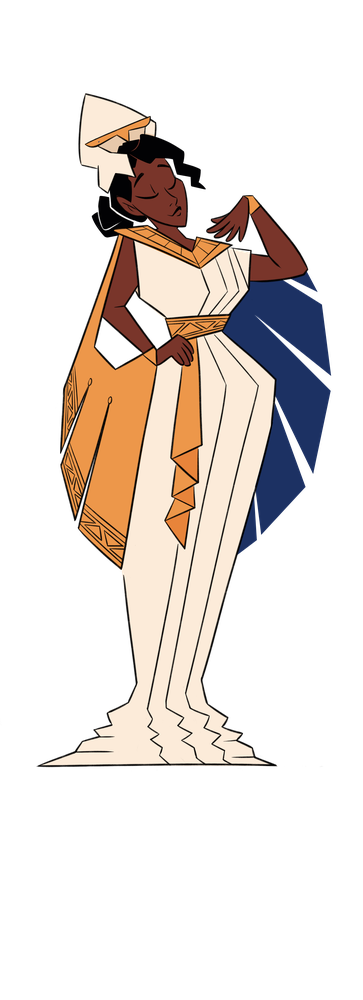
Athens — Athene · blue
Strength: discovering and expanding. After conquering a target Polis, Athene places 2 extra Phalanxes directly in that Polis the same turn. Home output: 5 FP + 1 AP — fast, but short on AP.
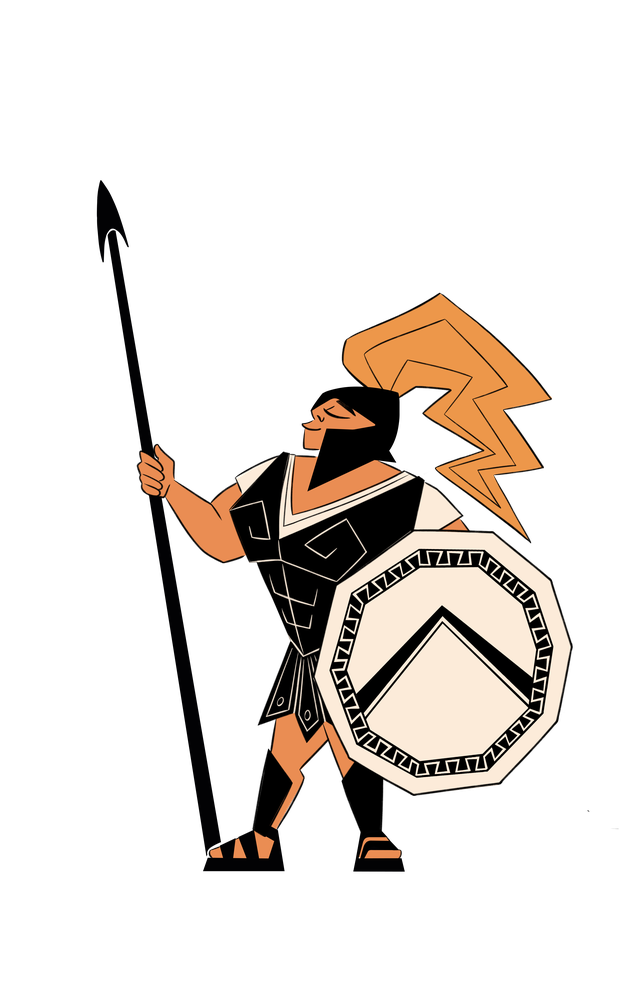
Sparta — Leonidas · black
Strength: conquering. Spartan dice replace normal dice and their hits count double; losses bank on the EUNOMIA token and cash in 2 : 1 (Learning Book, page 22). Home output: 3 AP + 2 FP — strong armies, short on movement.
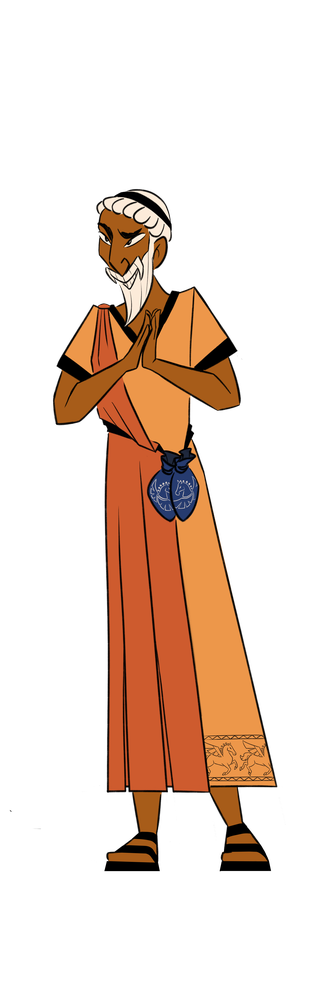
Corinth — Sisyphos · terracotta
Strength: economy and security. The Builder / Fortification action (Learning Book, page 28), and the only faction with a permanent home Mint (Pegasus). Home output: 2 FP + 1 AP + 1 Minted Coin.

Thebes — Phix · cream
Strength: decisive local superiority and economy. Oblique Order: three times per game, add 4 extra dice to one combat-round roll, on attack or defense — roll your normal dice (max 4) first, then the 4 extra as a second pass. Both passes form one combat-round roll: their hits are added together and the enemy fires back only afterwards (announce before rolling; once per roll). Home output: 2 FP + 1 AP + 1 Minted Coin.
At setup, place three of your single (×1) Phalanxes on the token to track the three charges. Each time you use a charge, return one to your supply. An empty token is spent.
Unminted Coins — full picture
An Unminted Coin is a broad wildcard with four uses (and nothing beyond these):
- Wildcard for 1 FP or 1 AP, at 1 : 1, any time — for movement, recruiting, building, and combat AP. (It is worth more than 1 FP/AP, so spend it this way only when short — see the box.)
- Counts as a full coin in the regular Coin ranking — but not in the Mint ranking (it bears no design).
- Fills coin combos on the Combo and Flush cards, lowering the card's VP the more "blanks" you use. It then leaves you together with the card's other coins.
- Trade & transactions — a valid item in transactions; generated by neutral trade (where it blocks a group) and by Democracy.
The Three Kinds of Polis
| Kind | Examples | Defense | Notes |
| Native Polis | Athens, Sparta, Corinth, Thebes | Cannot be attacked | Each faction's home; pays the full printed offer in Prosperity. |
| Wealthy Polis | Assos, Milet, Ephesos, Naxos | 4 Phalanxes | Resource-rich; pays 1 Minted Coin in Prosperity. Gold border and gold maze. |
| Common Polis | all others | 2 Phalanxes | Pays 1 FP or 1 AP in Prosperity. Dark orange maze. |
Key Terms
Active player The player whose turn it is.
Army Points (AP) Red resource. Recruit Phalanxes (1 AP → 4 Phalanxes).
Builder Corinth piece. Builds Fortifications in winter.
Combat round One side firing during a combat; defender and attacker alternate (see Learning Book, page 20).
Common Polis Any other neutral city. 2 Phalanxes defense.
Control You control a Polis once you take it — as your starting Native Polis, by conquest, or by handover (by agreement the owner moves out and you move in — one action each) — and mark it with a control marker. Control persists even when no units stand on the tile, until a rival conquers it. Control is what counts for Prosperity, the Poleis ranking, the Mint ranking, and Monopoly cards.
Fleet Points (FP) Blue resource. Move armies and build trade links.
Hero A Phalanx with a special ability: Navigator, Fighter, or Assassin (Aristocracy only).
King Monarchy piece. Does not fight; strengthens Phalanxes on its tile.
Mint A Polis that lets you score coins of its design in the Mint ranking. A Mint is not a source of coins.
Minted Coin A coin bearing a mint's design. Used in trade, scoring, and coin-combo Mission Cards.
Native Polis A faction's home city. Cannot be attacked.
Phalanx A Greek combat unit. Plural: Phalanxes. Has 1 hit point. The ×1 / ×5 / ×10 tokens are only denominations for making change — not units of different value.
Printed offer The resources shown on a Polis tile (its FP, AP, and/or coin symbols) — what a Native Polis pays in Prosperity, and what any Polis offers in trade.
Trade link A bridge between two neighboring Poleis.
Trade route A chain of trade links and Poleis.
Unminted Coin A neutral coin. Wildcard for 1 FP or 1 AP, and more (see page 6).
Wealthy Polis A resource-rich neutral city. 4 Phalanxes defense.
Year The game's unit of time: 431 BC → 421 BC, eleven years in all. Each year has four seasons: spring, summer, fall, winter.
Often Overlooked
Each point is a rule that new players often overlook. Page numbers refer to the Learning Book unless the Reference Book is named.
Actions
- Discover — "Name the space first, then take the tile." (12)
- Coins in trade — "Every Minted Coin a trade pays out is drawn blind from the coin bag, exactly as in Prosperity. Trading with a Mint gives you no particular coin." (14)
- No Unminted Coin left — "the trade still happens; no coin is placed, not even later." (31)
- Trade between players — "No new Unminted Coin is placed in a player-to-player trade, and blocked groups do not apply." (15)
- Recruit — "You may spend any number of AP in one Recruit action." (17)
- Convergence — "The converging units arrive with the move, before any combat; you cannot add them during or after a combat." (19)
- Transactions — "What you say about a traded item must be true — a transaction takes effect at once." (11)
- Trade links — "Several players may each build a trade link between the same two Poleis — there is no limit." (13)
Combat
- King after leaving Monarchy — "It then strengthens only the first 4 dice of your first combat round in each combat it takes part in: these 4 dice hit on 2–6, every later die on 3–6." (23)
- Fortifications — "A Fortification on the tile takes the attacker's hits first; beyond that, the player who is hit chooses which Phalanxes they lose." (20)
- Spartan dice — "Before each combat round, Sparta freely chooses how many banked losses to spend." "As with all dice, at most 4 Spartan dice count in a single combat-round roll." (22)
- Conquest — "When you conquer a Polis, you take all Unminted Coins lying on it behind your screen." (20)
Scoring
- Poleis ranking — "Count the Poleis each player controls." (25)
- Empty fist — "An empty fist gets no rank and no VP — only players who commit at least 1 coin are ranked." (25)
- Mint ranking — "you may commit only coins whose mint you currently control." (25)
- Combo and flush cards — "Combo and flush coins leave you." (Reference Book, page 2)
Factions and Builder
- Builder — "In winter, every Builder in play automatically erects one Fortification where it stands (not in the Native Polis)." (28)
- Start player — "Put the drawn token back into the bag; the bag stays with that player." (7)